

How to Fix Golf Cart Lithium Battery BMS Tripping
How to Fix Golf Cart Lithium Battery BMS Tripping
When your golf cart lithium battery BMS tripping happens the instant you punch the throttle or climb a grade, the whole cart goes dark — and that's the battery's BMS protecting the cells, not a dead battery. Three things trip it: peak current blows past the overcurrent (OCP) limit; a hard discharge makes voltage sag and trips undervoltage (UVP) protection even when nothing's actually wrong; or the inrush current when the main contactor snaps shut fools the short-circuit protection. Here's the part that saves you money: about 90% of these trips are fixed by lowering the controller's current limit in its app — no battery swap required. For a fix that actually sticks, parallel a second pack or upgrade the cables and pre-charge resistor.
Golf cart lithium battery BMS tripping is when the battery management system cuts power to protect the pack. It happens for three reasons: (1) overcurrent — the controller demands more amps than the BMS limit; (2) voltage sag — terminal voltage drops below the low-voltage cutoff under load; and (3) inrush current — the contactor surge trips short-circuit protection by mistake.
Table of Contents
- Why Your Golf Cart Lithium Battery BMS Is Tripping
- Diagnostic Decision Tree
- 5-Step Quick Self-Check
- Fix #1: Controller Software Tuning (Zero Cost)
- Fix #2: Hardware Upgrades (Permanent)
- Real-World Cases
- FAQ
Why Your Golf Cart Lithium Battery BMS Is Tripping
After you bolt in a high-power controller (Navitas 600A, Alltrax 500A), the current demand at takeoff jumps. The lithium BMS wasn't set for that, so one stomp of the pedal blacks out the cart. Here's what's fighting each other:
- Not enough burst amps. Most 100Ah packs ship with a 100A continuous / 200A peak (3-second) BMS. On a steep grade the controller asks for 350A — straight past the OCP limit, so the BMS cuts.
- Voltage sag. Even if current stays under the OCP line, extreme discharge plus cable resistance drags the terminal voltage below the BMS low-voltage cutoff (a 48V pack dropping under ~40V), tripping UVP even though the cells are fine.
- Inrush current. The instant the main contactor closes, the controller's big capacitors suck a microsecond surge that trips the BMS short-circuit protection.

Diagnostic Decision Tree
Run this tree to pin down your root cause, then compare what the battery can actually deliver against what the controller is asking for.


5-Step Quick Self-Check
|
Step
|
Check | Spec | Action |
| 1 |
Terminal torque
|
Main +/- posts 8–10 Nm
|
Tighten, clean oxide
|
| 2 |
Cable gauge
|
4 AWG or 2 AWG
|
Replace thin/corroded stock wire
|
| 3 |
Pre-charge resistor
|
Measure across contactor
|
Replace if blown
|
| 4 |
Controller limit
|
≤ 90% of BMS peak
|
Lower current limit in app
|
| 5 |
Cell voltage spread
|
< 0.05V
|
If > 0.1V, balance on slow charge
|
Fix #1: Controller Software Tuning (Zero Cost)
Before you buy any hardware, fix the software first — it stops most repeat trips for free.
Navitas TAC2 / DC Controllers
Use the Navitas Dashboard app (Bluetooth):
- Battery Current Limit: default 600A → set to 85–90% of the BMS peak. If your BMS peaks at 200A, set 175–180A.
- Acceleration Ramp Rate: move from "Aggressive/Sport" to "Smooth/Medium" so the 0–0.5s surge comes on gentler.
- Regen Braking: drop it too, so a long downhill doesn't feed power back and trip overvoltage (OVP) protection.
Alltrax XCT Controllers
Use the Alltrax Toolkit:
| Parameter |
Stock (aggressive)
|
Anti-trip setting
|
Effect
|
|
Max Battery Amps
|
400–500A
|
180–220A (match BMS)
|
Caps total battery current
|
|
Throttle Rate (Up)
|
25% / Fast
|
10–15% / Medium
|
Flattens surge, delays peak
|
|
Battery Peak Amps Duration
|
5 sec
|
1–2 sec
|
Keeps peak inside BMS window
|
Fix #2: Hardware Upgrades (Permanent)
Parallel a Second Battery Pack
When one pack's BMS rating falls short, add an identical pack in parallel:
- Original: 48V 67Ah (150A peak)
- Added: 48V 67Ah (150A peak)
- Combined: 48V 134Ah (60A continuous / 300A peak)
Two BMS units share the load, so each carries half. Range doubles, internal resistance (ESR) halves, and the voltage sag that was tripping you nearly disappears.
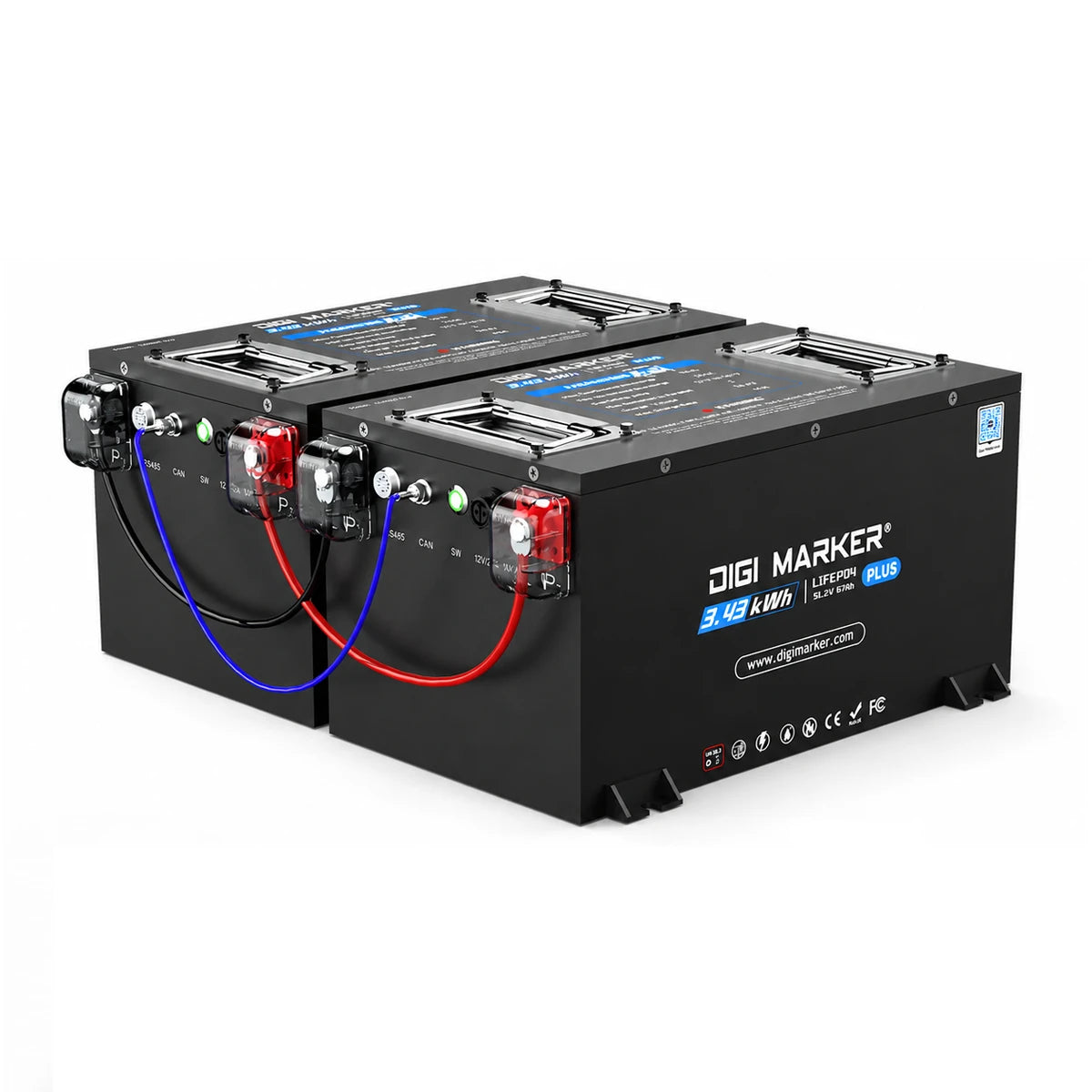
Want a pack already built for this? The DIGI CS-Plus 48V 134Ah Golf Cart Lithium Battery gives you the doubled capacity and peak headroom out of the box.
Upgrade Cables and Contactor
- Run 2/4 AWG flexible welding cable. The stock 6/8 AWG lead-acid wire has high resistance; under load the drop is huge and triggers UVP fast.
- Heavy contactor + pre-charge resistor. Swap in a 200A/400A continuous-rated contactor and bridge its big terminals with a 250–500Ω / 10–25W pre-charge resistor. It keeps the capacitors pre-charged and kills the closing-surge short-circuit hit.
Real-World Cases
Case 1 — EZGO TXT + Navitas 600A + single 105Ah lithium
- Symptom: Fine on flat ground, but black-screened the second two passengers sat in back or it climbed a steep hill.
- Diagnosis: Hill-start demand hit 320A; the BMS cutoff was only 250A / 3 sec.
- Fix: Battery Limit 600A → 210A, Throttle Acceleration 12%/sec. Top speed unchanged, hill starts smooth, and acceleration still beat the old lead-acid.
Case 2 — Club Car DS + Alltrax 500A + hill-climb demand
- Symptom: After software limiting, the climbs felt weak.
- Fix: Kept 500A output and paralleled a 48V 50Ah pack. Peak discharge rose to 400A, the grade trips stopped, and power came back strong.
FAQ
Q: Why does my lithium golf cart lose power on hills?
A: On a climb the controller asks for a sudden current (often 300A+) that exceeds the BMS overcurrent limit, or the voltage sag trips undervoltage protection. Nine times out of ten, it's one of those two.
Q: How do I reset a BMS trip fast?
A: Some BMS units auto-reset in 10–60 seconds. Others need the key off / main disconnect opened, and a few want the charger connected to wake them. If you keep needing a power cycle to reset, your limits aren't set right — lower the controller current.
Q: Will limiting current in software cut my top speed?
A: Usually not. You're capping the peak climb current, not the cruise current, so flat-ground top speed stays about the same — and takeoffs feel smoother.
Q: Is paralleling two batteries safe?
A: Same model, same voltage, same capacity in parallel is safe and is the forum-favorite fix. The two BMS units split the load, so each carries half.
Q: What does the pre-charge resistor do?
A: Before the contactor closes, it slowly charges the controller capacitors, wiping out the microsecond inrush that would otherwise trip the short-circuit protection by mistake.
Conclusion
A golf cart lithium battery BMS tripping on hills or hard acceleration is almost never a dead pack — it's a mismatch between what your controller asks for and what your BMS will allow. Start with the free fix: drop the controller's current limit and soften the throttle ramp in the app, and about 90% of trips disappear with no parts swapped. If you still need more climb power, parallel a second pack or run thicker cable with a proper pre-charge resistor so the voltage sag stops fooling the protection.
If you'd rather skip the wiring, the DIGI CS-Plus 48V 134Ah Golf Cart Lithium Battery ships with the doubled capacity and 300A peak headroom that keeps most upgrades trip-free out of the box.
You May Like


